FRB 20251229A
GCN Circular 43433
Rosa L. Becerra (UNAM), Noémie Globus (UNAM), Stéphane Basa (UAR Pytheas), William H. Lee (UNAM), Alan M. Watson (UNAM), Jean-Luc Atteia (IRAP), Edilberto Aguilar-Ruiz (UNAM),
Dalya Akl (NYUAD), Camila Angulo (UNAM), Sarah Antier (IJCLAB), Nathaniel R. Butler (ASU), Damien Dornic (CPPM), Jean-Grégoire Ducoin (CPPM), Francis Fortin (IRAP), Leonardo García García (UNAM), Ramandeep Gill (UNAM), Asuka Kuwata (UNAM), Nikos Mandarakas (LAM), Diego López-Cámara (UNAM), Francesco Magnani (CPPM), Enrique Moreno Méndez (UNAM), Margarita Pereyra (UNAM), Ny Avo Rakotondrainibe (LAM), Fredd Sánchez Álvarez (UNAM), Benjamin Schneider (LAM) and Antonio de Ugarte Postigo (LAM), report:
We reinspected our previous observations of the field of FRB 20251229A (Mulyk et al., GCN Circ. 43334) reported by Globus et al. (GCN Circ. 43431), focusing on the updated baseband localization provided by the CHIME/FRB Collaboration (Mason et al., GCN Circ. 43431).
We analysed the data and performed image subtraction using STDWeb/STDPipe (Karpov 2025), with templates from the Pan-STARRS DR2 catalog (Flewelling et al. 2020). In this further inspection, we do not detect any new source or evidence for brightness variability of any object within the localization uncertainty region (Mason et al., GCN Circ. 43431), down to the following 5-sigma limits:
r > 22.5,
z > 21.5.
We thank the staff of the Observatorio Astronómico Nacional on the Sierra de San Pedro Mártir and the COLIBRÍ and DDRAGO engineering teams.
COLIBRÍ is an astronomical observatory developed and operated jointly by France (AMU, CNES and CNRS) and Mexico (UNAM and SECIHTI). It is located at the Observatorio Astronómico Nacional on the Sierra de San Pedro Mártir, Baja California, Mexico.
GCN Circular 43431
Mason Ng (McGill University, Trottier Space Institute) on behalf of the CHIME/FRB Collaboration:
In GCN 43334 (ATel 17574), we reported the discovery of the potentially hyperactive repeating fast radio burst source, FRB 20251229A. In that ATel, we published best-fit localization coordinates from an initial analysis of the raw voltage (baseband) data using an older version of the localization pipeline (Michilli et al. 2021). Here, we update the best-fit baseband localization for FRB 20251229A using a newer version of the pipeline, with the latest calibration methods. The new localization, which is approximately 35" away from the previously reported localization (GCN 43334, ATel 17574), is the following with errors quoted at 1-sigma uncertainty:
RA (J2000): 20h 41m 23.9s +/- 1.8s, Dec. (J2000): 16d 01' 31" +/- 36"
RA (J2000): 310.3494 +/- 0.0077 deg., Dec. (J2000): 16.0252 +/- 0.0099 deg.
GCN Circular 43339
Noémie Globus (UNAM), Jean-Luc Atteia (IRAP), Alan M. Watson (UNAM), Stéphane Basa (UAR Pytheas), William H. Lee (UNAM), Dalya Akl (NYUAD), Camila Angulo (UNAM), Sarah Antier (IJCLAB), Rosa L. Becerra (UNAM), Nathaniel R. Butler (ASU), Damien Dornic (CPPM), Jean-Grégoire Ducoin (CPPM), Francis Fortin (IRAP), Leonardo García García (UNAM), Ramandeep Gill (UNAM), Nikos Mandarakas (LAM), Kin Ocelotl López (UNAM), Diego López-Cámara (UNAM), Francesco Magnani (CPPM), Enrique Moreno Méndez (UNAM), Margarita Pereyra (UNAM), Ny Avo Rakotondrainibe (LAM), Fredd Sánchez Álvarez (UNAM), Benjamin Schneider (LAM) and Antonio de Ugarte Postigo (LAM), report:
We imaged the field of FRB 20251229A (Mulyk et al., GCN Circ. 43334), using the DDRAGO two-channel wide-field imager on the COLIBRÍ telescope. We observed from 2026-01-06 02:08 to 02:42 UTC and obtained 29 minutes of simultaneous exposure in the r and z filters.
The data were reduced and coadded with the COLIBRÍ ASU pipeline. The photometry was calibrated using nearby stars from the PanSTARRS DR1 catalog, is in the AB system, and was not corrected for Galactic extinction.
In the stacked image, we do not detect any new source at the uncertainty region (Mulyk et al., GCN Circ. 43334) down to the following preliminary 5-sigma limits:
r > 22.99,
z > 21.88.
We thank the staff of the Observatorio Astronómico Nacional on the Sierra de San Pedro Mártir and the COLIBRÍ and DDRAGO engineering teams.
COLIBRÍ is an astronomical observatory developed and operated jointly by France (AMU, CNES and CNRS) and Mexico (UNAM and SECIHTI). It is located at the Observatorio Astronómico Nacional on the Sierra de San Pedro Mártir, Baja California, Mexico.
GCN Circular 43334
Nicole Mulyk (McGill University, Trottier Space Institute) on behalf of the CHIME/FRB Collaboration:
The CHIME/FRB Collaboration reports the detection of three bursts from a new repeating fast radio burst (FRB) source over the last week, with TNS designation FRB 20251229A. These bursts were detected on 2025-12-29 22:00:58, 2026-01-01 21:56:03, and 2026-01-03 21:53:36 UTC (400 MHz, topocentric). The first two detections were streamed through our VOEvents service. The third burst did not trigger a VOEvents notification as its signal-to-noise ratio was below the trigger threshold of 12 (see table below; Abbott et al. 2025). The rapid succession of these bursts in combination with the low declination of the source (+16 degrees; see below), and low CHIME exposure of only ~5 minutes per day (see note below), provides evidence of high activity. Additionally, this FRB source has a relatively low DM of 192.145 +/- 0.013 pc/cm^3, calculated by structure-maximizing the time profile using the highest signal-to-noise burst (Seymour, Michilli, & Pleunis 2019). The expected Galactic contribution along this line of sight is 93.6 or 75.3 pc/cm^3 from NE2001 (Cordes & Lazio 2002) or YMW16 (Yao, Manchester & Wang 2017), respectively. The large disparity between the predicted maximum Galactic DM from both models, and the much larger source DM, strongly suggests this is an extragalactic source. Assuming an average contribution of the intergalactic medium to the DM (Macquart et al. 2020), we expect the FRB’s redshift to be within ~0.1.
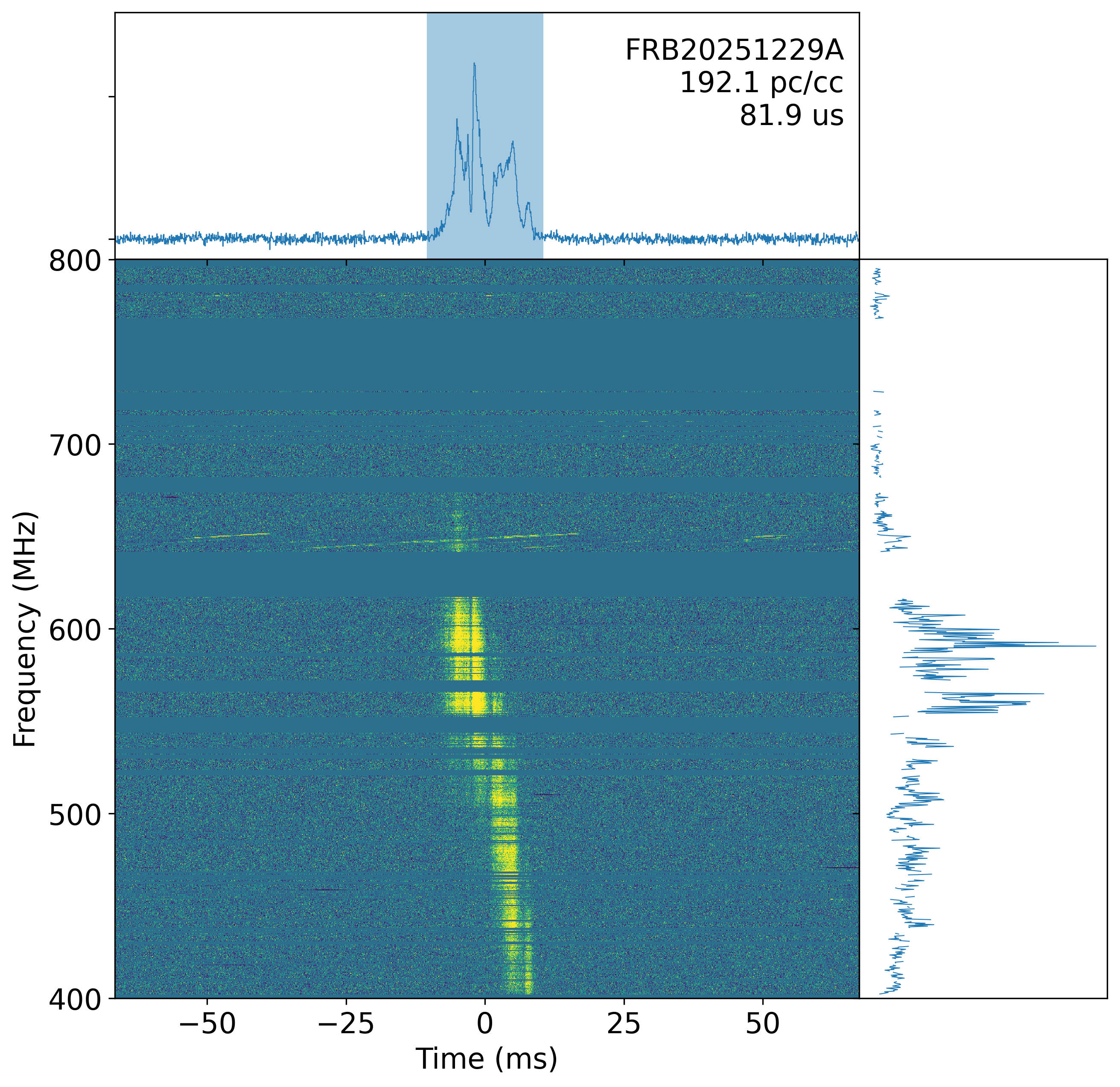
Initial analysis of the raw voltage data of the brightest event from 2026-01-01 provides a best-fit localization, of RA (J2000): 20h41m26.3s +/- 1.2s, Dec (J2000): 16°01’24” +/- 18”, with errors quoted at 1-sigma uncertainty (Michilli et al. 2021). Using the raw voltage data for the 2026-01-01 burst, we obtain a peak flux of 30 +/- 3 Jy and a 400 to 800 MHz band-averaged fluence of 160 +/- 16 Jy ms (CHIME/FRB Collaboration 2024). We have attached the waterfall plot for the 2026-01-01 burst in the link at the end of this ATel.
Due to the potentially high repetition rate and relative proximity of the source, we encourage multi-wavelength follow-up.
Note: This is compared to a “typical” daily exposure of ~15 minutes near zenith (see also Fig. 5 of CHIME/FRB Collaboration 2021, ApJS, 257, 59).
Topocentric Burst 400 MHz Arrival Time (UTC) | Detection Signal to Noise (S/N) Ratio : 2025-12-29 22:00:58 | 13.36 2026-01-01 21:56:03 | 47.90 2026-01-03 21:53:36 | 11.25
Waterfall plot: https://storage.googleapis.com/chimefrb-dev.appspot.com/FRB20251229A/FRB20251229A_wfall.png