



GRB 240821A
GCN Circular 38077
S. Giarratana (INAF-OAB), M. Giroletti (INAF-IRA),
G. Ghirlanda (INAF-OAB), N. Di Lalla (Stanford Univ.),
N. Omodei (Stanford Univ.), O. S. Salafia (INAF-OAB)
At 04:55:36 UT on 2024 Sept 18 (T_mid = 27.5 days post-burst)
and at 05:38:46 UT on 2024 Oct 8 (T_mid = 47.5 days post-burst)
the Karl G. Jansky VLA observed the field of GRB 240821A
(Fermi GBM team, GCN 37219; SVOM team, GCN 37220, 37226)
in three bands, with central frequencies of 6, 10 and 15 GHz.
The standard 3C48 was used as bandpass and flux density
calibrator, while J2358-1020 was used as phase calibrator.
From a preliminary analysis, we do not detect the radio counterpart
of GRB 240821A. We derive the following upper limits (UL; 3sigma):
==================================================
T_mid Freq UL r.m.s. Beam PA
[days] [GHz] [uJy] [uJy/b] [arcsec] [deg]
==================================================
27.5 6 21 7 1.07x0.78 -21
27.5 10 22 7 0.82x0.48 -10
27.5 15 27 9 0.57x0.32 -16
47.5 6 21 7 1.26x0.46 71
47.5 10 27 9 0.91x0.28 66
47.5 15 24 8 0.51x0.20 73
==================================================
We would like to thank the staff of the VLA for approving, executing,
and processing the observations.
The National Radio Astronomy Observatory is a facility of the National
Science Foundation operated under cooperative agreement by Associated
Universities, Inc.
These observations were carried out as part of project SF171028,
approved in the framework of the Fermi - NRAO joint program agreement.
GCN Circular 37931
WeiKang Zheng, Thomas G. Brink, Alexei V. Filippenko (UC Berkeley), and Yi
Yang (Tsinghua Univ., Beijing), report on behalf of the KAIT GRB team:
We observed the location of the GRB 240821A optical afterglow
(Quirola-Vasquez et al., GCN 37319) with the Low Resolution Imaging
Spectrometer (LRIS; Oke et al. 1995) with the Keck I 10 m telescope by
centering on the slit the host-galaxy counterpart from the Legacy Survey as
noticed by Quirola-Vasquez et al. (GCN 37319). Observations were performed
on Sep. 2, 2024, and consisted of 4 x 1200 s exposures with the 600/4000
grism and 400/8500 grating. The spectrum has low signal-to-noise ratio
owing to the faintness of the host galaxy. We detect and confirm the
emission line at 8123 Ang reported by Saccardi et al. (GCN 37369) and
Schneider et al. (GCN 37731) from VLT/X-shooter data. The [N II] 6584 and
possibly [O II] 3727 emission lines reported by Schneider et al. (GCN 37731)
are marginally detected. These results confirm the host-galaxy redshift of
z = 0.238.
The data presented herein were obtained at the W. M. Keck Observatory,
which is operated as a scientific partnership among the California
Institute of Technology, the University of California, and the National
Aeronautics and Space Administration. The Observatory was made possible by
the generous financial support of the W. M. Keck Foundation. The authors
wish to recognize and acknowledge the very significant cultural role and
reverence that the summit of Maunakea has always had within the indigenous
Hawaiian community. We are most fortunate to have the opportunity to
conduct observations from this mountain.
GCN Circular 37731
B. Schneider (MIT), A. Rossi (INAF-OAS), M. Ferro (INAF-OAB), H. Fausey (GWU), A. L. Thakur (INAF-IAPS), A. Martin-Carrillo (UCD), D. B. Malesani (DAWN/NBI and Radboud Univ.), N. R. Tanvir (U. Leicester), A. J. Levan (Radboud Univ. and Warwick Univ.), J. T. Palmerio (CEA), A. Saccardi (GEPI/Obs. de Paris), S. D. Vergani (GEPI/Obs. de Paris) report on behalf of the Stargate collaboration:
We observed the location of the SVOM and Fermi short GRB 240821A (Cangemi et al., GCN 37220; He et al., GCN 37226; Murphy et al., GCN 37232; Dalessi & Meegan, GCN 37239, Quirola-Vasquez et al., GCN 37319) with the X-shooter spectrograph mounted on the ESO VLT UT3 (Melipal) as a follow-up to our previous VLT/X-shooter observation (Saccardi et al., GCN 37369). The observation consisted of two consecutive observations of 4x1200 s each, with mid-times at 03:53:33 UT and 05:18:58 UT on 2024 October 1 (~40.4 days after the trigger). The seeing delivered is significantly better than for our previous observation reported in GCN 37369.
In addition to the emission line at 8120 AA mentioned by Saccardi et al. (GCN 37369), which is clearly detected also in the new spectra, two fainter features are also visible. This allows solving the conundrum from the previous observation, as the three lines nicely match [O II] 3729, H alpha, and [N II] 6584, all at a common redshift z = 0.238.
We acknowledge the expert support from the ESO observing staff at Paranal, in particular Jonathan Smoker and Cedric Ledoux.
GCN Circular 37533
S. Giarratana (INAF-OAB), M. Giroletti (INAF-IRA),
G. Ghirlanda (INAF-OAB), N. Di Lalla (Stanford Univ.),
N. Omodei (Stanford Univ.), O. S. Salafia (INAF-OAB)
At 04:07:30 UT on 2024 September 6 (T_mid = 15.43 days post-burst)
the Karl G. Jansky VLA observed the field of GRB 240821A
(Fermi GBM team, GCN 37219; SVOM team, GCN 37220, 37226) at a
central frequency of 6, 10 and 15 GHz.
The standard 3C48 was used as bandpass and flux density
calibrator, while J2358-1020 was used as phase calibrator.
From a preliminary analysis, we do not detect the radio counterpart
of GRB 240821A. During the observation, the VLA site was hit by a
thunderstorm, which heavily affected the success of the experiment.
We derive the following upper limits (UL; 3sigma):
==================================================
T_mid Freq UL r.m.s. Beam PA
[days] [GHz] [uJy] [uJy/b] [arcsec] [deg]
==================================================
15.43 6 51 17 1.75x0.93 -38
15.43 10 54 18 0.95x0.62 -29
15.43 15 130 43 0.87x0.38 -44
==================================================
We would like to thank the staff of the VLA for approving, executing,
and processing the observations.
The National Radio Astronomy Observatory is a facility of the National
Science Foundation operated under cooperative agreement by Associated
Universities, Inc.
These observations were carried out as part of project SF171028,
approved in the framework of the Fermi - NRAO joint program agreement.
GCN Circular 37369
A. Saccardi (GEPI/Obs. de Paris), M. Ferro (INAF-OAB), A. J. Levan (Radboud Univ. & Warwick Univ.), A. Rossi (INAF-OAS), S. D. Vergani (GEPI/Obs. de Paris), D. B. Malesani (DAWN/NBI and Radboud Univ.), B. P. Gompertz (U. Birmingham), A. Martin-Carrillo (UCD), K. Wiersema (Hertfordshire Univ.), D. Xu (NAOC), report on behalf of the Stargate collaboration:
Following the identification of the optical afterglow (Quirola-Vasquez et al., GCN 37319) of GRB 240821A (Cangemi et al., GCN 37220; He et al., GCN 37226; Murphy et al., GCN 37232; Dalessi & Meegan, GCN 37239), we obtained 4x1200 s of observations with the X-shooter instrument at the ESO VLT UT3 (mid time 2024 Aug 30.3578 UT, that is, 8.8 days after the trigger). These observations reveal a continuum across the spectral range 4000-20000 AA, and a single clear emission line at 8120 AA. While the presence of a substantial continuum blueward of 8120 AA rules out that this line is Ly-alpha, it is difficult to conclusively determine a redshift value based on only a single line. We consider three possibilities below.
A) The emission line could arise from the [O II] doublet (3726, 3729) at z = 1.18. In this scenario the other strong emission lines lie in the IR regime, where sensitivity is poorer and sky background higher. The observed spectral energy distribution of the host galaxy from the Legacy and VISTA surveys would also provide the best match at this redshift. However, the resolution of X-shooter should clearly resolve the two components of the doublet, and, while a very weak excess may be present at 8215 AA (the expected location of the bluer component of the doublet), the observed intensity ratio would be inconsistent with the expectations for either high or low density media.
B) The line could be from [O III] (5007 AA) at z = 0.62. In this scenario, both [O III] 4959 and H-beta would lie in close proximity in the spectrum, although are expected to have lower flux, and hence poorer signal to noise than the observed line. There is no detection of any emission at the expected location of either.
C) The line may come from H-alpha at z = 0.24. Since H-alpha may well be the brightest line within the host galaxy (especially for a short-GRB host), the non-detection of other emission features at the same redshift, but at bluer wavelengths is less problematic because they may be fainter and/or extinguished. This may also be supported by an apparent decrease in the galaxy continuum at ~4500 AA, which could be due to the Balmer break, although the signal to noise is poor in this region.
The detection of a single line does not enable at the current time an unambiguous redshift determination, but does suggest it must be one of the above possibilities. We note that all of these lie outside the formal 1-sigma range of the photometric redshift determination from the Legacy survey (z = 0.488 +/- 0.074; Zhou et al. 2021, MNRAS, 501, 3309). Further analysis is ongoing, and we will update the community should this reveal a stronger conclusion regarding the burst redshift.
We acknowledge expert help of the ESO observing staff at Paranal, in particular Thomas Rivinius and Matias Jones.
GCN Circular 37323
J. Durbak (UMD), E. Troja (U Rome), S. Atri(U Rome), A. S. Kutyrev (NASA/GSFC), O. Guiffreda (UMD), K. De (MIT), S. B. Cenko (NASA/GSFC)
Following the SVOM localization (GCN 37220), we observed the field of GRB 240821A in H-band with PRIME ~30 hours after the trigger. The total exposure time was 1800s.
At the position of the candidate optical counterpart (GCN 37319), we detect a source with H~20 mag, calibrated versus nearby 2MASS stars and not corrected for Galactic extinction.
Further observations to assess variability are planned.
PRIME is a 1.8m telescope with 1.56 square degree FOV (0.5 arcsec/pixel) located in Sutherland, South Africa at the South African Astronomical Observatory (SAAO) (Kutyrev et al. 2023, Yama et al. 2023).
We thank the Osaka University observers at PRIME and the staff at SAAO for their support with these observations.
GCN Circular 37319
J. Quirola-Vasquez (Radboud Univ.), D. B. Malesani (DAWN/NBI and Radboud Univ.), A. J. Levan (Radboud Univ. & Warwick Univ.), P. G. Jonker (Radboud Univ), F. E. Bauer (PUC), J. van Dalen (Radboud Univ.), M. E. Ravasio (Radboud Univ.), D. Mata Sanchez (IAC), M. A. P. Torres (IAC), A. Martin-Carrillo (UCD), S. D. Vergani (GEPI / Obs. de Paris) report on behalf of a larger collaboration:
We observed the location of the candidate X-ray afterglow Turpin et al., GCN 37230; Bernardini et al., GCN 37249; Turpin et al., GCN 37316) discovered by Einstein Probe within the SVOM/ECLAIR localization of GRB 240821A (Cangemi et al., GCN 37220; He et al., GCN 37226; Murphy et al., GCN 37232; Dalessi & Meegan, GCN 37239). Observations were carried out in the z band using the GMOS-N instrument on the Gemini North telescope, on two epochs: 2024 August 22 (0.73 days after the GRB) and 2024 August 28 (6.58 days after the GRB). The first epoch was affected by the bright, nearby Moon.
Several sources are visible consistent with the X-ray afterglow error region (10" radius). Carrying out image subtraction between the two epochs, a clear transient is detected at the following coordinates (J2000):
RA = 23:37:04.90
Dec = -10:11:22.2
An (unresolved) archival counterpart is well detected at these coordinates in the Legacy Survey, with a magnitude z ~ 22 AB. The optical transient is slightly offset (~0.5") from its nucleus, ruling out AGN variability. The Legacy Survey catalog (Zhou et al. 2021, MNRAS, 501, 3309) provides a photometric redshift 0.488 +- 0.074.
Given the joint fading of the optical and X-ray flux, we consider this target to be the likely optical afterglow + host of GRB 240821A.
We thank the EP / SVOM teams for privately sharing the location of the X-ray source prior to GCN dissemination.
GCN Circular 37316
D. Turpin (CEA), H. Q. Cheng, H. Sun, W. Xie (NAOC, CAS), Y. F. Liang (PMO, CAS), J. Q. Peng (IHEP, CAS), W. Yuan (NAOC, CAS), S. Guillot (IRAP), J. Guan, C. K. Li, Y. Chen, S. M. Jia, W. W. Cui, D. W. Han, W. Li, C. Z. Liu, F. J. Lu, L. M. Song, J. Wang, J. J. Xu, J. Zhang, S. N. Zhang, H. S. Zhao, X. F. Zhao (IHEP, CAS), Y. Liu, C. C. Jin, C. Zhang, Z. X. Ling, J. Wang, L. P. Xin (NAOC, CAS), E. Kuulkers, A. Santovincenzo (ESA), P. O'Brien (Univ. of Leicester), K. Nandra, A. Rau (MPE), B. Cordier (CEA) on behalf of the SVOM and Einstein Probe teams
We performed two additional epochs of follow-up observation of GRB 240821A (Cangemi et al, GCN 37220; He et al. GCN 37226; Fermi/GBM GCN 37219) with the Follow-up X-ray Telescope (FXT) on board the Einstein Probe (EP) mission. The observation started at epoch 2: 2024-08-22T09:46:59 and epoch3 2024-08-26T10:00:08 (T-TGRB ~ 0.63 and 4.64d, respectively ) each for about 8 ks of exposure in total. In addition, we reprocessed the data of the first epoch (Turpin et al., GCN 37230) with 5 ks of total exposure.
In total, considering the 3 epochs of observation, we detected 25 uncatalogued individual X-ray sources within a radius of 13 arcmin centered at RA, DEC = 354.23 deg, -10.18 deg (Cangemi et al, GCN 37220).
- 9 sources have only one detection in either epoch 2 or 3 and are not consistent with the Swift/XRT source positions. We do not consider these sources as credible afterglow candidates.
- 14 sources are detected in at least two epochs but are consistent, within errors, with no flux variability as function of time. 3 of them are consistent in position and flux measurement with the Swift/XRT source #1, #2 and #4 (Evans et al., GCN 37249). We do not consider these sources as credible afterglow candidates.
- 2 sources are detected in the epochs 1 and 2, but were not detected in the third epoch (even if an excess is marginally detected for one of them), showing a clear sign of fading behavior across the three epochs. Therefore, they are considered as credible afterglow candidates.
The following table lists the detailed information of these two X-ray candidates detected by EP-FXT. The positions are given with an uncertainty of 10 arcsec (radius, 90% C.L. statistical and systematic). The fluxes are given based on the observations of FXT-B. The measured fluxes of the epoch 1 and epoch 2 are calculated in the 0.5 - 10 keV energy range and the uncertainties are at the 90% confidence level. The upper limits of the epoch 3 are calculated using the best-fitting parameter obtained by fitting the X-ray spectra of epoch 2 and given in the 0.5 - 10 keV at the 90% confidence level.
EP-FXT source #1
RA, DEC (J2000) = 354.2701 deg, -10.1911 deg
-----------------------------------------------------------
| epoch # | TGRB-Tstart | exposure | Estimated Flux |
| | hr | ks | (erg/s/cm^2) |
-----------------------------------------------------------
| 1 | 8.8 | 5.0 | 1.1(+/-0.2) x 10^-13 |
| 2 | 15.2 | 8.0 | 5.9(+/-1.3) x 10^-14 |
| 3 | 111.4 | 8.4 | < 1.5 x 10^-14 |
-----------------------------------------------------------
EP-FXT source #2
RA, DEC(J2000) = 354.1516 deg, -10.0504 deg
-----------------------------------------------------------
| epoch # | TGRB-Tstart | exposure | Estimated Flux |
| | hr | ks | (erg/s/cm^2) |
-----------------------------------------------------------
| 1 | 8.8 | 5.0 | 6.0(+/-1.3) x 10^-14 |
| 2 | 15.2 | 8.0 | 3.5(+/-1.0) x 10^-14 |
| 3 | 111.4 | 8.4 | < 3.4 x 10^-14 |
-----------------------------------------------------------
The EP-FXT source #1 is spatially consistent with the Swift/XRT #3 source (Evans et al., GCN 37249). It is the brightest X-ray counterpart found in the first epoch and the decreasing of the flux is compatible with the reported XRT flux within errors.
The EP-FXT source #2 is actually marginally detected in the third epoch thus the upper limit presented in the above table is not significantly lower than the flux measured in the second epoch.
We suggest that the EP-FXT source #1 is the most promising X-ray afterglow candidate of GRB 240821A. We strongly encourage further optical and NIR follow-up of this sky position RA, DEC (J2000) = 354.2701 deg, -10.1911 deg (10” error radius) with large telescopes to potentially detect late time kilonova/supernova emission associated with this short GRB+extended emission.
The above observation was made with the EP-FXT instrument. Launched on January 9, 2024, EP is a space X-ray observatory to monitor the soft X-ray sky with X-ray follow-up capability (Yuan et al. 2022, Handbook of X-ray and Gamma-ray Astrophysics). EP is a mission of the Chinese Academy of Sciences in collaboration with ESA, MPE and CNES.
GCN Circular 37262
S. P. R. Shilling (Lancaster U.) and S. R. Oates (Lancaster U.) reports on behalf
of the Swift/UVOT team:
The Swift/UVOT began settled observations of the field of GRB 240821A
91 ks after the Fermi/GBM trigger (Fermi GBM team, GCN Circ. 37219). The
UVOT exposures include the positions of XRT sources 1, 2, 3 and 4
(Bernardini et al., GCN 37249).
We note there is a DSS source (J233641.30-100258.0, Rmag ~20.76) coincident with
the XRT source 2 position, and a USNO-B1.0 source (0798-0668880, Bmag ~18.31)
coincident with the XRT source 4 position. There are no DSS or USNO-B1.0 sources
at the positions of XRT sources 1 and 3.
Preliminary magnitudes, and upper limits, using the UVOT photometric system
(Breeveld et al. 2011, AIP Conf. Proc. 1358, 373) for the four XRT sources are:
Source Filter T_start(s) T_stop(s) Exp(s) Mag
XRT source 1 u 91622 93293 1643 >20.92
XRT source 2 u 91622 93293 1643 20.73 +/- 0.30
XRT source 3 u 91622 93293 1643 >20.92
XRT source 4 u 91622 93293 1643 18.27 +/- 0.05
XRT source 1 w2 136400 153663 3261 >21.42
XRT source 2 w2 136400 153663 3261 20.55 +/- 0.18
XRT source 3 w2 136400 153663 3261 >21.43
XRT source 4 w2 136400 153663 3261 20.66 +/- 0.20
The magnitudes in the table are not corrected for the Galactic extinction
due to the reddening of E(B-V) = 0.01 in the direction of the burst
(Schlegel et al. 1998).
GCN Circular 37251
Stéphane Basa (UAR Pytheas), William H. Lee (UNAM), S. Antier (OCA), Alan
M. Watson (UNAM), and D. Akl (AUS)
report on behalf of:
Colibri Science Team: Jean-Luc Atteia (IRAP), Nathaniel R. Butler (ASU),
Damien Dornic (CPPM), J.-G. Ducoin (CPPM), Francis Fortin (IRAP), Simona
Lombardo (LAM), Francesco Magnani (CPPM), and Margarita Pereyra (UNAM),
Colibri Engineering Team: François Dolon (UAR Pytheas), François Agneray
(LAM), Fernando Angeles (UNAM), Thomas Auphan (CPPM), Hafid Benamar (CPPM),
Jérémie Boy (IRAP), Edgar Cadena Zepeda (UNAM), Salvador Cuevas (UNAM),
Alejandro Farah (UNAM), Liliana Figueroa Carrilo (UNAM), Johan Floriot
(LAM), Jorge Fuentes-Fernandez (UNAM), Pascal Gallais (CEA), Rosalía
Langarica (UNAM), Arthur Langlois (IRAP), Julien Lecubin (UAR Pytheas),
Eduardo López Ángeles (UNAM), Erica E. Lugo-Ibarra (UNAM), Adrien Malgoyre
(UAR Pytheas), Chrystel Moreau (LAM), José Luis Ochoa Abundis (UNAM),
María H. Pedrayes-López (UNAM), Samuel Ronayette (CEA), Aurelia Secroun
(CPPM), Jaime Ruiz Díaz-Soto (UNAM), Silvio Tinoco (UNAM), and
Hervé Valentin (IRAP)
SVOM JSWG: Jian-Yan Wei (NAOC), Bertrand Cordier (CEA), Shuang-Nan Zhang
(IHEP), Stéphane Basa (LAM), Jean-Luc Atteia (IRAP), Arnaud Claret (CEA),
Zi-Gao Dai (USTC), Frédéric Daigne (IAP), Jin-Song Deng (NAOC), Andrea
Goldwurm (APC), Diego Götz (CEA), Xu-Hui Han (NAOC), Cyril Lachaud (APC),
En-Wei Liang (GXU), Yu-Lei Qiu (NAOC), Susanna Vergani (Obs.Paris), Jing
Wang (NAOC), Chao Wu (NAOC), Li-Ping Xin (NAOC), Bing Zhang (UNLV)
We imaged the field of GRB 240821A detected by SVOM/ECLAIRs/GRM, Fermi-GBM,
EIRSAT-1 GMOD (GCN circ. 37219, 37220, 37226, 37227, 37232, 37239)) during
the commissioning of the Colibri (SVOM/F-GFT) telescope at the Observatorio
Astronómico Nacional on the Sierra de San Pedro Mártir in Mexico.
The observations started 11.1 hours after the GRB trigger and finished 3.5
hour later. We obtained 7530 seconds of exposure with the engineering test
camera in a red filter that approximates SDSS r. The proximity of the
source to the moon made the limits relatively shallow.
The data have been reduced by a single data processing pipeline STDPIPE
(Karpov et al., 2022) and calibrated against the PS1 catalog.
We do not find any optical counterpart in a field of 13 arcmin to a side
centered on RA, Dec = 354.23, -10.18 (J2000).
We estimate an upper limit of 20 mag in r-band (5 sigma).
Note that EP-FXT sources and Swift-XRT sources are in the field of view of
Colibri (GCN 37230, GCN 37249)
This report is consistent other optical observations by GRANDMA (GCN
37225), GMG (GCN 37242), SVOM/VT (GCN 37243), Jinshan (GCN 37245), LCO (GCN
37246), REM (GCN 37247).
We warmly thank the COLIBRI engineering team, D. Turpin, A. Klotz, S.
Karpov, E. Jiménez Bailon, and the staff of the Observatorio Astronómico
Nacional on the Sierra de San Pedro Mártir.
GCN Circular 37249
M.G. Bernardini (INAF-OAB), J.A. Kennea (PSU), A. Tohuvavohu (U.
Toronto), D.N. Burrows (PSU), K.L. Page (U. Leicester), A.P. Beardmore
(U. Leicester), E. Ambrosi (INAF-IASFPA) , M. Capalbi (INAF-IASFPA)
and P.A. Evans (U. Leicester) reports on behalf of the Swift-XRT team:
Swift-XRT has performed follow-up observations of the
Fermi/GBM,SVOM/ECLAIRs,SVOM/GRM-detected burst GRB 240821A
(GCN circ. 37219, 37220, 37226, 37227, 37239), collecting
5.0 ks of Photon Counting (PC) mode data between T0+91.4 ks
and T0+153.6 ks.
Four uncatalogued X-ray sources have been detected, however none of
them is above the RASS limit or shows definitive signs of fading.
Source 2 is consistent with the position of galaxy SDSS
J233641.30-100258.0.
The XRT detected sources are detected also in EP-FXT data (GCN Circ.
37230).
The Swift/XRT and EP-FXT fluxes are consistent within the errors.
Therefore, at the present time we cannot identify which, if any, is the
afterglow.
Details of these sources are given below:
Source 1:
RA (J2000.0): 354.2899 = 23:37:9.58
Dec (J2000.0): -10.0537 = -10:03:13.2
Error: 7.1 arcsec (radius, 90% conf.)
Count-rate: (1.90 [+0.98, -0.74])e-3 ct s^-1
Distance: 501 arcsec from SVOM/ECLAIRs position.
Flux: (6.2 [+3.2, -2.4])e-14 erg cm^-2 s^-1 (observed, 0.3-10 keV)
Source 2:
RA (J2000.0): 354.1713 = 23:36:41.12
Dec (J2000.0): -10.0495 = -10:02:58.0
Error: 7.4 arcsec (radius, 90% conf.)
Count-rate: (2.49 [+1.09, -0.86])e-3 ct s^-1
Distance: 513 arcsec from SVOM/ECLAIRs position.
Flux: (8.2 [+3.6, -2.8])e-14 erg cm^-2 s^-1 (observed, 0.3-10 keV)
Source 3:
RA (J2000.0): 354.2700 = 23:37:4.80
Dec (J2000.0): -10.1882 = -10:11:17.6
Error: 10.3 arcsec (radius, 90% conf.)
Count-rate: (1.53 [+0.83, -0.63])e-3 ct s^-1
Distance: 144 arcsec from SVOM/ECLAIRs position.
Flux: (6.6 [+3.6, -2.7]e-14 erg cm^-2 s^-1 (observed, 0.3-10 keV)
Source 4:
RA (J2000.0): 354.1714 = 23:36:41.14
Dec (J2000.0): -10.1776 = -10:10:39.4
Error: 5.8 arcsec (radius, 90% conf.)
Count-rate: (1.30 [+0.80, -0.59])e-3 ct s^-1
Distance: 207 arcsec from SVOM/ECLAIRs position.
Flux: (3.0 [+1.8, -1.3])e-14 erg cm^-2 s^-1 (observed, 0.3-10 keV)
The results of the XRT-team automatic analysis of the XRT observations,
including a position-specific upper limit calculator, are available at
https://www.swift.ac.uk/ToO_GRBs/00021704.
This circular is an official product of the Swift-XRT team.
GCN Circular 37247
M. Ferro, P. D’Avanzo, R. Brivio, Y.-D. Hu, S. Campana, S. Covino, D. Fugazza, M. G. Bernardini (INAF-OAB), Reguitti A. (INAF-OAB / INAF-OAPd), Melandri A. (INAF-OAR), S. D. Vergani (Obs.Paris), report on behalf of the REM team:
We observed the field of the short GRB 240821A detected by Fermi/GBM (Fermi GBM Team, GCN 37219; Preis et al., GCN 37221), SVOM/ECLAIR and SVOM/GRM (Cangemi et al., GCN 37220) with the REM 60cm robotic telescope located at the ESO observatory of La Silla (Chile). The observations were carried in the g, r, i, z, J, H bands, starting on 2024 August 23 at 00:59:16 UT (i.e. 30.22 hours after the Fermi trigger), and lasting for about 1.5 hours.
From preliminary photometry performed on the 10'x10' REM fov around the SVOM/ECLAIR position, we did not detect potential afterglow candidates consistent with the four X-rays counterparts by EP-FXT (Turpin et al., GCN 37230), and the two Swift-XRT candidates (Evans, GCN 37236), within the covered region, down to the following 3sigma magnitude upper limits:
H > 14.5 (Vega; calibrated against the 2MASS catalogue)
at a mid-time of t - t0 = 31.22 hours after the Fermi trigger,
i > 19.3 (AB; calibrated against the SkyMapper catalogue)
at a mid-time of t - t0 = 31.13 hours after the Fermi trigger.
GCN Circular 37246
L. Izzo (INAF-OACn and DARK/NBI) and D. B. Malesani (DAWN/NBI and Radboud Univ.) report:
We observed the field of GRB 240821A (Fermi GBM Team, GCN #37219; Cangemi et al., GCN #37220; He et al., GCN #37226; Murphy et al., GCN #37232; Dalessi et al., GCN #37239) with the Sinistro instrument mounted on the 1-m telescope of the LCO network, located at the Cerro Tololo Inter-American Observatory, Chile. Observations started on 2024 August 22 at 09:39 UT (15.05 hr after the GRB trigger). We obtained a series of 8x120 s images in the SDSS-i filter.
We centered the telescope at the coordinates provided by SVOM/GRM (Cangemi et al., GCN #37220), giving us the possibility to cover the entire error region recommended by the SVOM team.
Given the proximity of a bright Moon, the final stacked image is contaminated by moonlight. We did not detect any new source within the several X-rays counterparts error regions reported by EP-FXT (Turpin et al., GCN #37230) up to a limit of i = 20.7 mag. For some of the X-ray detections provided by the EP-FXT, objects are visible within the EP error circles but are consistent with archival sources.
This project has received funding from the European Union's Horizon 2020 research and innovation program under grant agreement No 101004719.
GCN Circular 37245
S.Q. Jiang, J. An, Z.P. Zhu, X. Liu, S.Y. Fu, D. Xu (NAOC), J.Z. Liu (XAO) report on behalf of a large collaboration:
We observed the field of GRB 240821A detected by Fermi (GCN 37219 & GCN 37239), SVOM (GCN 37220 & GCN 37226), and EIRSAT-1 (GCN 37232), using the 100cm-C telescope (100C) located at Altay, Xinjiang, China. Observations started at 18:43:03.73 UTC on 2024-08-22, i.e., 24.12 hr after the Fermi trigger, and a series of frames were obtained in the Sloan i- and z- bands.
No new optical source is detected within the EP/FXT (Turpin et al., GCN 37230) and Swift/XRT (Evans et al., GCN37236) error circles, down to the following 3-sigma optical upper limits:
Source | R.A. | Dec. | Mag_i | Mag_z
------------------------------------------------------------
EP J233704.9-101126 | 354.2703 | -10.1905 | >20.0 | >19.4
EP J233641.3-100257* | 354.1720 | -10.0491 | >20.2 | >19.4
EP J233641.6-101036 | 354.1735 | -10.1767 | >20.2 | >19.4
EP J233642.1-101318 | 354.1754 | -10.2217 | >20.2 | >19.4
EP J233708.1-101515 | 354.2836 | -10.2542 | >20.0 | >19.4
EP J233710.3-100324+ | 354.2929 | -10.0566 | >20.0 | >19.4
EP J233727.8-100744 | 354.3657 | -10.1290 | >20.0 | >19.4
EP J233636.5-100302 | 354.1522 | -10.0507 | >20.2 | >19.4
XRT Source1+ | 354.28992 | -10.05366 | >20.0 | >19.4
XRT Source2* | 354.17265 | -10.04975 | >20.2 | >19.4
calibrated with nearby PanSTARRS stars and the magnitudes are not corrected for Galactic extinction. The sources marked with the same symbol (i.e., * and +) are very likely an identical one detected by both EP/FXT and Swift/XRT.
We acknowledge the excellent support from S.W. Luo, Z.K. Feng, M.M. Yang, and L.F. Huo for enabling these observations.
GCN Circular 37243
SVOM/VT commissioning team: Y.L.Qiu, L.P.Xin, H.L.Li, H.B.Cai, Y.Xu, Y.J.Xiao, P.P.Zhang, L.Lan, W.J.Xie, X.M.Lu, R.S.Zhang, D.W.Xu, G.W.Li (NAOC), J.Zhang, L.J. Dan,G.Y.Zou,C.J. Wang,Y.F.Du, C.Huang (XIOPM)
SVOM JSWG: Jian-Yan Wei (NAOC), Bertrand Cordier (CEA), Shuang-Nan Zhang (IHEP), Stéphane Basa (LAM), JeanLuc Attéia (IRAP), Arnaud Claret (CEA), Zi-Gao Dai (USTC), Frédéric Daigne (IAP), Jin-Song Deng (NAOC), Andrea Goldwurm (APC), Diego Götz (CEA), Xu-Hui Han (NAOC), Cyril Lachaud (APC), En-Wei Liang (GXU), Yu-Lei Qiu (NAOC), Susanna Vergani (Obs.Paris), Jing Wang (NAOC), Chao Wu (NAOC), Li-Ping Xin (NAOC), Bing Zhang (UNLV)
report on behalf of the SVOM team:
During the commissioning phase, GRB 240821A (Cangemi et al., GCN 37220; He et al. GCN 37226; Murphy et al., GCN 37232; Dalessi et al., GCN 37239) was observed by the SVOM/VT telescope started at 2024-08-22T11:34:02 UT (about 17 hours after the burst) in ToO mode. VT made the observations with two channels simultaneously, VT_B (400nm-650nm) and VT_R (650nm-1000nm). No new source was detected within the errorbox of EP-FXT sources (Turpin et al., GCN 37230) and Swift-XRT sources (Evans et al., 37236), down to the limit magnitude of about 23.0 mag in VT stacked images in both channels, compared to the DESI DR10 catalog.
More detailed analysis is ongoing.
The Space Variable Objects Monitor (SVOM) is a China-France joint mission led by the Chinese National Space Administration (CNSA, China), National Center for Space Studies (CNES, France) and the Chinese Academy of Sciences (CAS, China), which is dedicated to observing gamma-ray bursts and other transient phenomena in the energetic universe. VT is an optical telescope on board SVOM with an aperture of 44 cm, designed to automatically follow the Eclairs triggers. It has two channels: VT_B and VT_R, covering wavelengths from 400 nm to 650 nm and 650 nm to 1000 nm, respectively. The two bands are observed simultaneously. VT was jointly developed by Xi'an Institute of Optics and Precision Mechanics (XIOPM), CAS and National astronomical observatories (NAOC),CAS.
The SVOM/VT point of contact for this burst is: Liping Xin (xlp@nao.cas.cn)
GCN Circular 37242
R.-Z. Li, B.-T. Wang, F.-F. Song, J. Mao, K.-X. Lu and J.-M. Bai (YNAO, CAS) report:
We observed the field of GRB 240821A, reported by Fermi/GBM (GCN 37219, GCN 37239), SVOM/ECLAIRs (GCN 37220, T0 at 2024-08-21T18:35:50.150), GRANDMA/LesMakes-T60 (GCN 37225), SVOM/GRM (GCN 37226), EP/FXT (GCN 37230) and Swift ToO (GCN 37236), using the GMG-2.4m telescope at Lijiang Observatory.
The observation began at 2024-08-22T16:10:10, about 21.57 hours after the SVOM/ECLAIRs trigger.
No new reliable optical counterpart was detected in the 2x600s stacked image within the 10-arcsec EP/FXT error circle of the afterglow candidate EP J233704.9-101126 (Turpin et al., GCN 37230), down to a 5-sigma limiting magnitude of R ~ 19.6, derived from calibration against the USNO-A2.0 field stars.
The detection limit was relatively shallow because of the lunar phase and the angular distance between the target and the Moon.
GCN Circular 37241
V. Lipunov, V.Kornilov, E. Gorbovskoy, K. Zhirkov, N.Tyurina, P.Balanutsa, A.Kuznetsov, V.Senik, D. Vlasenko,
G.Antipov, D.Zimnukhov, E.Minkina, A.Chasovnikov, V.Topolev, D.Kuvshinov, D. Cheryasov, Ya.Kechin, Yu.Tselik, A. Sosnovskij
(Lomonosov Moscow State University, SAI, Physics Department),
R. Podesta, C.Lopez, F. Podesta, C.Francile
(Observatorio Astronomico Felix Aguilar OAFA),
R. Rebolo, M. Serra
(The Instituto de Astrofisica de Canarias),
D. Buckley
(South African Astronomical Observatory),
O.A. Gress, N.M. Budnev, O.Ershova
(Irkutsk State University, API),
L.Carrasco, J.R.Valdes, V.Chavushyan, V.M.Patino Alvarez, J.Martinez,
A.R.Corella, L.H.Rodriguez
(INAOE, Guillermo Haro Astrophysics Observatory),
A. Tlatov, D. Dormidontov
(Kislovodsk Solar Station of the Pulkovo Observatory),
V. Yurkov, A. Gabovich
(Blagoveschensk Educational State University)
MASTER-Tavrida robotic telescope (Global MASTER-Net: http://observ.pereplet.ru, Lipunov et al., 2010, Advances in Astronomy, vol. 2010, 30L) located in Russia (Lomonosov MSU, SAI Crimea astronomical station) started inspect of the Fermi GRB 240821A ( Fermi GBM team, GCN 37219) errorbox 1 days 11047 sec after notice time and 1 days 11085 sec after trigger time at 2024-08-22 21:40:48 UT, with upper limit up to 17.0 mag. The observations began at zenith distance = 63 deg. The sun altitude is -34.5 deg.
The galactic latitude b = -64 deg., longitude l = 59 deg.
Real time updated cover map and OT discovered available here:
https://master.sai.msu.ru/site/master2/observ.php?id=2570719
We obtain a following upper limits.
Tmid-T0 | Date Time | Site | Coord (J2000) |Filt.| Expt. | Limit| Comment
_________|_____________________|_____________________|____________________________________|_____|_______|_______|________
97516 | 2024-08-22 21:40:48 | MASTER-Tavrida | (23h 06m 54.54s , -17d 17m 48.9s) | C | 60 | 16.4 |
97516 | 2024-08-22 21:40:48 | MASTER-Tavrida | (23h 06m 50.07s , -17d 13m 08.7s) | C | 60 | 16.9 |
98446 | 2024-08-22 21:56:18 | MASTER-Tavrida | (23h 06m 53.97s , -17d 18m 53.9s) | C | 60 | 16.6 |
98446 | 2024-08-22 21:56:18 | MASTER-Tavrida | (23h 06m 50.55s , -17d 13m 54.7s) | C | 60 | 16.9 |
99379 | 2024-08-22 22:11:51 | MASTER-Tavrida | (23h 06m 50.26s , -17d 19m 26.2s) | C | 60 | 16.8 |
99379 | 2024-08-22 22:11:51 | MASTER-Tavrida | (23h 06m 47.36s , -17d 14m 28.2s) | C | 60 | 17.0 |
100157 | 2024-08-22 22:24:49 | MASTER-Tavrida | (22h 59m 52.74s , -14d 45m 47.2s) | C | 60 | 16.3 |
100157 | 2024-08-22 22:24:49 | MASTER-Tavrida | (22h 59m 49.79s , -14d 41m 23.5s) | C | 60 | 16.4 |
101080 | 2024-08-22 22:40:13 | MASTER-Tavrida | (22h 59m 50.97s , -14d 46m 12.6s) | C | 60 | 16.4 |
101081 | 2024-08-22 22:40:13 | MASTER-Tavrida | (22h 59m 50.53s , -14d 50m 04.6s) | C | 60 | 16.5 |
102011 | 2024-08-22 22:55:43 | MASTER-Tavrida | (22h 59m 45.94s , -14d 45m 08.3s) | C | 60 | 16.3 |
102011 | 2024-08-22 22:55:44 | MASTER-Tavrida | (22h 59m 42.81s , -14d 40m 49.3s) | C | 60 | 16.4 |
105751 | 2024-08-22 23:58:03 | MASTER-Tavrida | (23h 00m 04.79s , -16d 05m 00.1s) | C | 60 | 16.4 |
105751 | 2024-08-22 23:58:03 | MASTER-Tavrida | (23h 00m 02.33s , -16d 00m 42.0s) | C | 60 | 16.2 |
105827 | 2024-08-22 23:59:19 | MASTER-Tavrida | (23h 08m 17.51s , -16d 05m 57.0s) | C | 60 | 16.3 |
105827 | 2024-08-22 23:59:19 | MASTER-Tavrida | (23h 08m 15.15s , -16d 01m 38.7s) | C | 60 | 16.2 |
106685 | 2024-08-23 00:13:37 | MASTER-Tavrida | (23h 00m 05.45s , -16d 05m 25.1s) | C | 60 | 16.2 |
106685 | 2024-08-23 00:13:38 | MASTER-Tavrida | (23h 00m 02.15s , -16d 00m 54.1s) | C | 60 | 16.2 |
106761 | 2024-08-23 00:14:53 | MASTER-Tavrida | (23h 08m 19.44s , -16d 06m 20.6s) | C | 60 | 16.1 |
106761 | 2024-08-23 00:14:54 | MASTER-Tavrida | (23h 08m 16.14s , -16d 01m 49.8s) | C | 60 | 16.1 |
107031 | 2024-08-23 00:19:24 | MASTER-Tavrida | (23h 02m 49.99s , -13d 31m 59.2s) | C | 60 | 15.9 |
107032 | 2024-08-23 00:19:24 | MASTER-Tavrida | (23h 02m 49.34s , -13d 36m 11.3s) | C | 60 | 15.9 |
107704 | 2024-08-23 00:30:36 | MASTER-Tavrida | (23h 00m 07.03s , -16d 07m 23.9s) | C | 60 | 16.2 |
107704 | 2024-08-23 00:30:36 | MASTER-Tavrida | (23h 00m 10.30s , -16d 11m 14.9s) | C | 60 | 15.9 |
107779 | 2024-08-23 00:31:52 | MASTER-Tavrida | (23h 08m 19.79s , -16d 08m 03.7s) | C | 60 | 16.1 |
107780 | 2024-08-23 00:31:52 | MASTER-Tavrida | (23h 08m 22.88s , -16d 11m 53.7s) | C | 60 | 16.2 |
108039 | 2024-08-23 00:36:11 | MASTER-Tavrida | (23h 02m 40.52s , -13d 33m 20.8s) | C | 60 | 16.2 |
108039 | 2024-08-23 00:36:11 | MASTER-Tavrida | (23h 02m 43.56s , -13d 37m 10.4s) | C | 60 | 16.2 |
Filter C is a clear (unfiltred) band.
The observation and reduction will continue.
The message may be cited.
GCN Circular 37239
S. Dalessi (UAH) and C. Meegan (UAH) report on behalf of
the Fermi Gamma-ray Burst Monitor Team:
"At 18:36:02.60 UT on 21 August 2024, the Fermi Gamma-ray Burst Monitor (GBM)
triggered and located GRB 240821A (trigger 745958167/240821775).
which was also detected by SVOM (F. Cangemi et al. 2024 GCN 37220, J. He et al. 2024 37226) and EIRSAT-1 (D. Murphy et al. 2024, GCN 37232).
The Fermi GBM on-ground location is consistent with the SVOM position.
The angle from the Fermi LAT boresight is 89 degrees.
The GBM light curve single emission episode with a duration (T90)
of about 1.9 s (50-300 keV). The time-averaged spectrum
from T0-0.2 to T0+2.9 s is best fit by
a power law function with an exponential high-energy cutoff.
The power law index is -0.93 +/- 0.06 and the cutoff energy,
parameterized as Epeak, is 370 +/- 40 keV.
The event fluence (10-1000 keV) in this time interval is
(3.9 +/- 0.2)E-06 erg/cm^2. The 64-ms peak photon flux measured
starting from T0+0.64 s in the 10-1000 keV band is 28 +/- 2 ph/s/cm^2.
A Band function fits the spectrum equally well with Epeak= 238 +/- 42 keV, alpha = -0.74 +/- 0.11 and beta = -1.96 +/- 0.11.
The spectral analysis results presented above are preliminary;
final results will be published in the GBM GRB Catalog:
https://heasarc.gsfc.nasa.gov/W3Browse/fermi/fermigbrst.html
For Fermi GBM data and info, please visit the official Fermi GBM Support Page:
https://fermi.gsfc.nasa.gov/ssc/data/access/gbm/"
GCN Circular 37236
P. A. Evans (U. Leicester) reports on behalf of the Swift team:

Swift has initiated a ToO observation of the Fermi/LAT GRB 240821A.
Automated analysis of the XRT data will be presented online at
https://www.swift.ac.uk/ToO_GRBs/00021704

Any uncatalogued X-ray sources detected in this analysis will be
reported on this website and via GCN COUNTERPART notices. These are
not necessarily related to the Fermi/LAT event. Any X-ray source
considered to be a probable afterglow candidate will be reported via a
GCN Circular after manual consideration.

Details of the XRT automated analysis methods are detailed in Evans et
al. (2007, A&A, 469, 379; 2009, MNRAS, 397, 1177 and 2014, ApJS, 210, 8).

This circular is an official product of the Swift-XRT team.
GCN Circular 37232
D. Murphy, C. McKenna, C. de Barra, A. Ulyanov, P. McDermott, M. Doyle, R. Dunwoody, J. Mangan, G. Finneran, L. Cotter, A. Empey, J. Fisher, F. Gibson Kiely, J. Thompson, D. McKeown, A. Martin-Carrillo, L. Hanlon, S. McBreen, on behalf of the EIRSAT-1 team:
EIRSAT-1 reports the detection of the short gamma-ray burst GRB240821A which was also detected by Fermi GBM (GCN 37219) and SVOM (GCN 37220, GCN 37226). The detection was made at 24-08-21 18:36:03.2 UTC.
The GMOD light curve for GRB240821A, with 1.2s binning shows a single peak. The spacecraft location at time of detection was 21.884 S, 54.418 E and an altitude of 490.5 km.
The light curve for this event as measured by GMOD can be found here: https://grb.eirsat1.ie/20240821A/20240821A_LC_onboard_preliminary.png
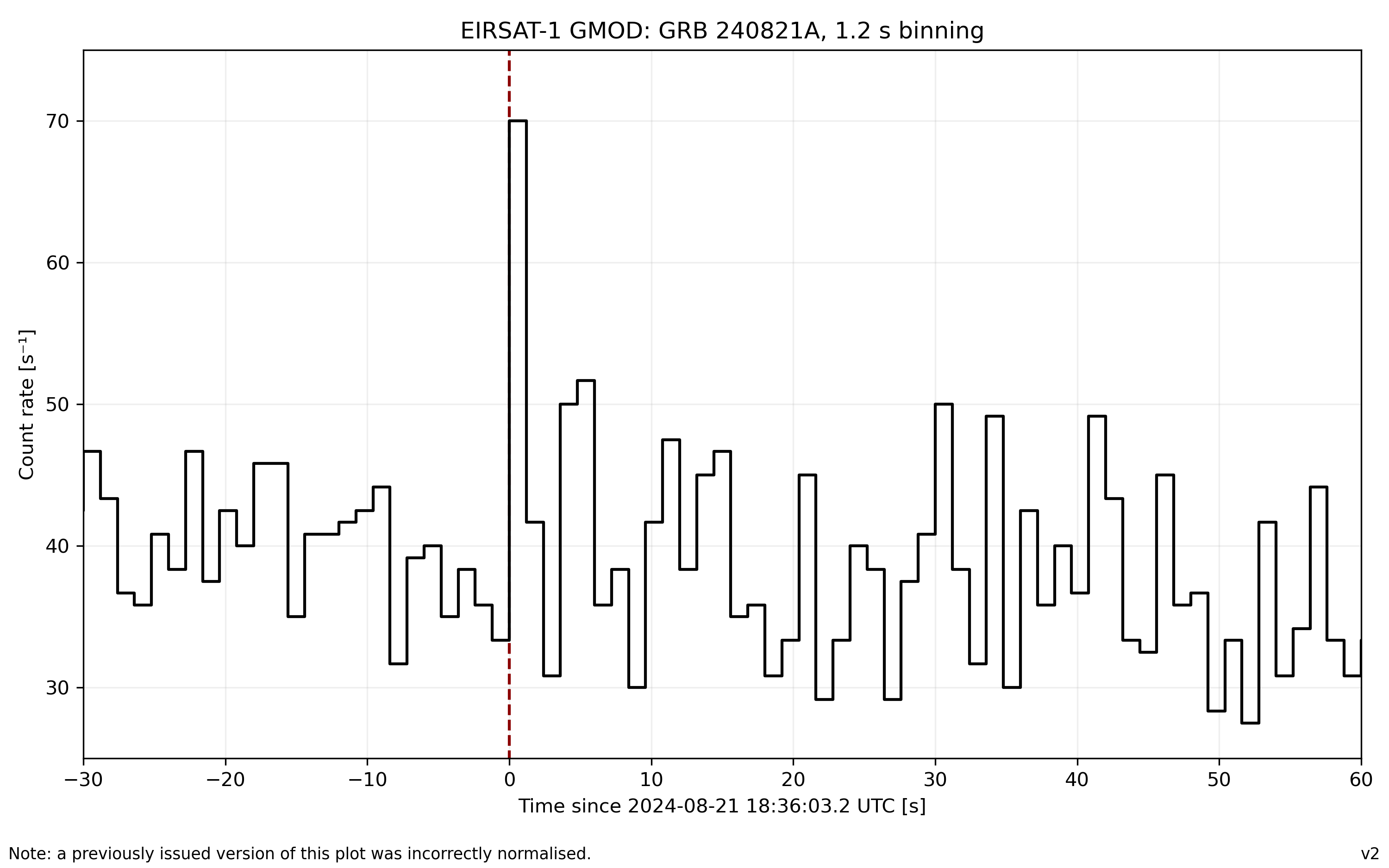
EIRSAT-1 is Ireland’s first satellite (Doyle et al. Proceedings of the 4th SSEA, 2022). It is a 2U CubeSat and carries onboard a number of experiments including the Gamma-Ray Module (GMOD), a novel, compact Gamma-ray detector (Murphy et al, Experimental Astronomy, 53, 961–990, 2022). GMOD consists of a 25 mm × 25 mm × 40 mm Cerium Bromide scintillator coupled to SiPMs and is designed to detect gamma-ray bursts in the ~ 60 keV - 1.5 MeV range. EIRSAT-1 was developed in University College Dublin with support from ESA’s Fly Your Satellite! programme and was launched on 1st December 2023.
GCN Circular 37230
D. Turpin (CEA), H. Q. Cheng, W. Xie (NAOC, CAS), Y. F. Liang (PMO, CAS), J. Q. Peng (IHEP, CAS), W. Yuan (NAOC, CAS), S. Guillot (IRAP), J. Guan, C. K. Li, Y. Chen, S. M. Jia, W. W. Cui, D. W. Han, W. Li, C. Z. Liu, F. J. Lu, L. M. Song, J. Wang, J. J. Xu, J. Zhang, S. N. Zhang, H. S. Zhao, X. F. Zhao (IHEP, CAS), H. Sun, Y. Liu, C. C. Jin, C. Zhang, J. Wang, L. P. Xin (NAOC, CAS), E. Kuulkers, A. Santovincenzo (ESA), P. O'Brien (Univ. of Leicester), K. Nandra, A. Rau (MPE), B. Cordier (CEA) on behalf of the SVOM and Einstein Probe teams
We performed a follow-up observation of GRB 240821A (detected by SVOM/ECLAIRs Cangemi et al, GCN 37220; SVOM/GRM He et al. GCN 37226 and Fermi/GBM GCN 37219) with the Follow-up X-ray Telescope (FXT) on board the Einstein Probe (EP) mission. The observation began at 2024-08-22T03:22:05 (T-TGRB ~ 9 hrs), and the exposure time is about 3.0 ks. FXT-A detected 2 uncatalogued sources in the 90% localization error circle provided by SVOM/ECLAIRs (with a radius of 13 arcmin centered at RA, DEC = 354.23 deg, -10.18 deg), and 7 are detected by FXT-B.
The following table lists the detailed information of the X-ray sources detected by FXT-A and FXT-B. The positions are given with an uncertainty of 10 arcsec (radius, 90% C.L. statistical and systematic). The uncertainties of flux are at the 90% confidence level.
FXT-A candidate list:
Source name | RA | DEC | Estimated Flux | SNR | Dist from SVOM/ECLAIRs |
| deg | deg | (erg/s/cm^2) | | offset (in arcmin) |
-------------------------------------------------------------------------------------------------
EP J233704.9-101126 | 354.2703 | -10.1905 | 1.3(+/-0.3) x 10^-13 | 7.6 | 2.46 |
EP J233641.3-100257 | 354.1720 | -10.0491 | 5.5(+/-2.2) x 10^-14 | 4.2 | 8.57 |
-------------------------------------------------------------------------------------------------
FXT-B candidate list:
Source name | RA | DEC | Estimated Flux | SNR | Dist from SVOM/ECLAIRs |
| deg | deg | (erg/s/cm^2) | | offset (in arcmin) |
-------------------------------------------------------------------------------------------------
EP J233704.9-101126 | 354.2696 | -10.1893 | 1.2(+/-0.3) x 10^-13 | 8.5 | 2.40 |
EP J233641.6-101036 | 354.1735 | -10.1767 | 7.5(+/-2.2) x 10^-14 | 5.1 | 3.34 |
EP J233642.1-101318 | 354.1754 | -10.2217 | 5.9(+/-2.0) x 10^-14 | 3.8 | 4.08 |
EP J233708.1-101515 | 354.2836 | -10.2542 | 3.0(+/-1.3) x 10^-14 | 4.3 | 5.46 |
EP J233710.3-100324 | 354.2929 | -10.0566 | 8.4(+/-3.0) x 10^-14 | 3.9 | 8.28 |
EP J233727.8-100744 | 354.3657 | -10.1290 | 4.0(+/-1.6) x 10^-14 | 4.6 | 8.58 |
EP J233636.5-100302 | 354.1522 | -10.0507 | 7.8(+/-2.2) x 10^-14 | 6.3 | 9.02 |
-------------------------------------------------------------------------------------------------
The above observation was made with the EP-FXT instrument. Launched on January 9, 2024, EP is a space X-ray observatory to monitor the soft X-ray sky with X-ray follow-up capability (Yuan et al. 2022, Handbook of X-ray and Gamma-ray Astrophysics). EP is a mission of the Chinese Academy of Sciences in collaboration with ESA, MPE and CNES.
GCN Circular 37227
SVOM/GRM team: Jiang He, Yong-Wei Dong, Jiang-Tao Liu, Shi-Jie Zheng, Jian-Chao Sun, Yue Huang, Wen-Jun tan, Chen-Wei Wang, Min Gao, Hao-Xuan Guo, Lu Li, Yong-Ye Li, Hong-Wei Liu, Xin Liu, Hao-Li Shi, Li-Ming Song, You-Li Tuo, Hao-Xi Wang, Jin Wang, Jin-Zhou Wang, Ping Wang, Rui-Jie Wang, Yu-Xi Wang, Bo-Bing Wu, Shao-Lin Xiong, Jian-Ying Ye, Yi-Tao Yin, Wen-Hui Yu, Fan Zhang, Li Zhang, Peng Zhang, Shuang-Nan Zhang, Wen-Long Zhang, Yan-Ting Zhang, Shu-Min Zhao, Xiao-Yun Zhao, Chao Zheng (IHEP), Maria-Grazia Bernardini (LUPM/INAF-OAB), Laurent Bouchet (IRAP), David Corre (CEA), Tais Maiolino (LUPM), Frédéric Piron (LUPM), Stéphane Schanne (CEA), Jingwei Wang (IAP)
SVOM JSWG: Jian-Yan Wei (NAOC), Bertrand Cordier (CEA), Shuang-Nan Zhang (IHEP), Stéphane Basa (LAM), JeanLuc Attéia (IRAP), Arnaud Claret (CEA), Zi-Gao Dai (USTC), Frédéric Daigne (IAP), Jin-Song Deng (NAOC), Andrea Goldwurm (APC), Diego Götz (CEA), Xu-Hui Han (NAOC), Cyril Lachaud (APC), En-Wei Liang (GXU), Yu-Lei Qiu (NAOC), Susanna Vergani (Obs.Paris), Jing Wang (NAOC), Chao Wu (NAOC), Li-Ping Xin (NAOC), Bing Zhang (UNLV)
report on behalf of the SVOM team:
During the commissioning phase, the SVOM/GRM was triggered in-flight by GRB 240821A (SVOM trigger reference: sb24082109) at 2024-08-21T18:36:02.700 UT (T0), which was also observed by SVOM/ECLAIRs (GCN 37220) and Fermi/GBM (GCN 37219).
The real-time alert data and light curves of SVOM/GRM were downlinked to the ground through the VHF system with low latency. The light curves show that this burst consists of multiple pulses with a duration of about 1 s.
The SVOM/GRM light curve can be found here:
http://www.bursthub.cn//admin/static/svgrb240821A.png
The Space Variable Objects Monitor (SVOM) is a China-France joint mission led by the Chinese National Space Administration (CNSA, China), National Center for Space Studies (CNES, France) and the Chinese Academy of Sciences (CAS, China), which is dedicated to observing gamma-ray bursts and other transient phenomena in the energetic universe. GRM is developed by the Institute of High Energy Physics (IHEP) of CAS.
The SVOM/GRM point of contact for this burst is: Jiang He (IHEP)(hejiang@ihep.ac.cn)
GCN Circular 37226
SVOM/GRM team: Jiang He, Yong-Wei Dong, Jiang-Tao Liu, Shi-Jie Zheng, Jian-Chao Sun, Yue Huang, Wen-Jun tan, Chen-Wei Wang, Min Gao, Hao-Xuan Guo, Lu Li, Yong-Ye Li, Hong-Wei Liu, Xin Liu, Hao-Li Shi, Li-Ming Song, You-Li Tuo, Hao-Xi Wang, Jin Wang, Jin-Zhou Wang, Ping Wang, Rui-Jie Wang, Yu-Xi Wang, Bo-Bing Wu, Shao-Lin Xiong, Jian-Ying Ye, Yi-Tao Yin, Wen-Hui Yu, Fan Zhang, Li Zhang, Peng Zhang, Shuang-Nan Zhang, Wen-Long Zhang, Yan-Ting Zhang, Shu-Min Zhao, Xiao-Yun Zhao, Chao Zheng (IHEP), Maria-Grazia Bernardini (LUPM/INAF-OAB), Laurent Bouchet (IRAP), David Corre (CEA), Tais Maiolino (LUPM), Frédéric Piron (LUPM), Stéphane Schanne (CEA), Jingwei Wang (IAP)
SVOM JSWG: Jian-Yan Wei (NAOC), Bertrand Cordier (CEA), Shuang-Nan Zhang (IHEP), Stéphane Basa (LAM), JeanLuc Attéia (IRAP), Arnaud Claret (CEA), Zi-Gao Dai (USTC), Frédéric Daigne (IAP), Jin-Song Deng (NAOC), Andrea Goldwurm (APC), Diego Götz (CEA), Xu-Hui Han (NAOC), Cyril Lachaud (APC), En-Wei Liang (GXU), Yu-Lei Qiu (NAOC), Susanna Vergani (Obs.Paris), Jing Wang (NAOC), Chao Wu (NAOC), Li-Ping Xin (NAOC), Bing Zhang (UNLV)
report on behalf of the SVOM team:
During the commissioning phase, the SVOM/GRM was triggered in-flight by GRB 240821A (SVOM trigger reference: sb24082109) at 2024-08-21T18:36:02.700 UT (T0), which was also observed by SVOM/ECLAIRs (GCN 37220) and Fermi/GBM (GCN 37219).
The real-time alert data and light curves of SVOM/GRM were downlinked to the ground through the VHF system with low latency. The light curves show that this burst consists of multiple pulses with a duration of about 1 s.
The SVOM/GRM light curve can be found here:
http://www.bursthub.cn//admin/static/svgrb240821A.png
The Space Variable Objects Monitor (SVOM) is a China-France joint mission led by the Chinese National Space Administration (CNSA, China), National Center for Space Studies (CNES, France) and the Chinese Academy of Sciences (CAS, China), which is dedicated to observing gamma-ray bursts and other transient phenomena in the energetic universe. GRM is developed by the Institute of High Energy Physics (IHEP) of CAS.
The SVOM/GRM point of contact for this burst is: Jiang He (IHEP)(hejiang@ihep.ac.cn)
GCN Circular 37225
A. Klotz (CNRS-OMP-IRAP), P. Thierry (AGORA), S. Antier (OCA), D. Akl (AUS), P.A. Duverne (APC), C. Andrade (UMN), S. Karpov (FZU), M. Coughlin (UMN), P. Hello (IJCLAB) , T. Pradier (Unistra/IPHC), N. Guessoum (AUS), S. Schanne (CEA-Saclay/Irfu), D. Turpin (CEA-Saclay/Irfu), S. Guillot (IRAP) on behalf of the GRANDMA collaboration:
We imaged the field of GRB 240821A detected by SVOM/ECLAIRs (GCN 37220) and Fermi-GBM (GCN 37219) with LesMakes-T60 at La Réunion.
The observations started ~1.4 hours after the GRB trigger (in Sloan r) and finished 1 hour later. Proximity to the moon made the limits relatively shallow.
The data have been reduced by a single data processing pipeline STDPIPE (Karpov et al., 2022). We do not find any optical counterpart within the ECLAIRs localization error box (7 arcmin centered on RA, Dec = 354.23, -10.18 (J2000)). We estimate an upper limit of 18.4 mag in r-band (5 sigma).
We thank SVOM for the useful communication. We use the SkyPortal application (skyportal.io) to monitor our observational campaign.
GRANDMA is a worldwide telescope network (grandma.ijclab.in2p3.fr) devoted to the observation of transients in the context of multi-messenger astrophysics (Antier et al. 2020 MNRAS 49, 5518).
GCN Circular 37221
T. Preis, B. Biltzinger, J. Burgess & J. Greiner (all MPE Garching) report:

The public trigdat data of the Fermi Gamma-ray Burst Monitor (GBM) trigger
745958167 at 18:36:02 on 21 Aug. 2024 were automatically fitted for spectrum
and sky location with BALROG (Burgess et al. 2018, MNRAS 476, 1427;
Berlato et al. 2019, ApJ 873, 60).

The best-fit position is:
RA(2000.0) = 352.9 deg
Decl.(2000.0) = -11.2 deg
The 1 sigma statistical error radius is 3.0 deg.
We estimate an additional systematic error of 1 deg.

Further details are available at:
https://grb.mpe.mpg.de/grb/GRB240821775/

The Healpix map can be downloaded from:
https://grb.mpe.mpg.de/grb/GRB240821775/healpix

The location parameters are available as JSON at:
https://grb.mpe.mpg.de/grb/GRB240821775/json
GCN Circular 37220
SVOM/ECLAIRs commissioning team: Floriane Cangemi (APC), Stéphane Schanne, Frédéric Chateau, Nicolas Dagoneau, Hervé Le Provost (CEA), Olivier Godet, Laurent Bouchet, Sebastien Guillot, Juliette Alaux (IRAP), Frédéric Piron (LUPM), Karine Mercier, Marie-Claire Charmeau, Stefano Crepaldi (CNES)
SVOM JSWG: Jian-Yan Wei (NAOC), Bertrand Cordier (CEA), Shuang-Nan Zhang (IHEP), Stéphane Basa (LAM), Jean-Luc Atteia (IRAP), Arnaud Claret (CEA), Zi-Gao Dai (USTC), Frédéric Daigne (IAP), Jin-Song Deng (NAOC), Andrea Goldwurm (APC), Diego Götz (CEA), Xu-Hui Han (NAOC), Cyril Lachaud (APC), En-Wei Liang (GXU), Yu-Lei Qiu (NAOC), Susanna Vergani (Obs.Paris), Jing Wang (NAOC), Chao Wu (NAOC), Li-Ping Xin (NAOC), Bing Zhang (UNLV)
report on behalf of the SVOM team:
GRB 240821A : A likely short GRB located on-board by SVOM/ECLAIRs.
During the commissioning phase, the SVOM/ECLAIRs telescope triggered and located GRB 240821A (sb24082109) a bright GRB at 2024-08-21T18:35:50.150 UT (T0), which was also detected by SVOM/GRM (GCN in preparation) and Fermi/GBM (GCN 37219).
The burst was detected by both the on-board Count-Rate Trigger (CRT) and Image Trigger (IMT) and 40 alerts were received on the ground with low-latency trough the SVOM VHF Alert Network. The best detection is obtained by IMT with a signal to noise ratio of 29.7 in the 8-120 keV energy band on a time window of 81.92 s starting at T0. The sub-image received shows a clear point-like source.
The transient location is RA, Dec = 354.23, -10.18 (J2000). This is about 23 degrees from the ECLAIRs optical axis, in the partially coded field of view. The statistical uncertainty on this position is 3 arcminutes, to which we recommend to add 10 arcminutes of systematic uncertainty. This position is 7° from the Fermi localization (GCN 37219) and thus consistent with it.
The light-curve of the GRB shows a bright spike, followed by fainter emission during about 100 seconds, suggesting a short GRB with extended emission.
SVOM did not slew to the burst since automated slewing is not yet enabled.
The Space Variable Objects Monitor (SVOM) is a China-France joint mission led by the Chinese National Space Administration (CNSA, China), French Space Agency (CNES, France) and the Chinese Academy of Sciences (CAS, China), which is dedicated to observing gamma-ray bursts and other transient phenomena in the energetic universe. ECLAIRs was developed jointly by APC, CEA, CNES and IRAP.
The SVOM point of contact for this burst is Sebastien Guillot: sebastien.guillot@irap.omp.eu
GCN Circular 37219
The Fermi GBM team reports the detection of a likely SHORT GRB

At 18:36:02 UT on 21 Aug 2024, the Fermi Gamma-ray Burst Monitor (GBM) triggered and located GRB 240821A (trigger 745958167.601766 / 240821775).

The on-ground calculated location, using the Fermi GBM trigger data, is RA = 348.4, Dec = -14.1 (J2000 degrees, equivalent to J2000 23h 13m, -14d 05'), with a statistical uncertainty of 2.0 degrees.

The angle from the Fermi LAT boresight is 89.0 degrees.

The skymap can be found here:
https://heasarc.gsfc.nasa.gov/FTP/fermi/data/gbm/triggers/2024/bn240821775/quicklook/glg_skymap_all_bn240821775.png

The HEALPix FITS file, including the estimated localization systematic, can be found here:
https://heasarc.gsfc.nasa.gov/FTP/fermi/data/gbm/triggers/2024/bn240821775/quicklook/glg_healpix_all_bn240821775.fit

The GBM light curve can be found here:
https://heasarc.gsfc.nasa.gov/FTP/fermi/data/gbm/triggers/2024/bn240821775/quicklook/glg_lc_medres34_bn240821775.gif